
Most Important Inquiries After Planting and How to Handle Them
Most Important Inquiries After Planting and How to Handle Them
There is nothing preventing you from praying after a hair transplant surgery, but you must follow these instructions during the first two weeks after the procedure to avoid negatively affecting the transplanted follicles:
Minimize head movement when bowing and prostrating to prevent any friction of the forehead with the ground.
You may suffice with praying while seated, as bending affects the stability of the follicles and increases blood pressure reaching them.
You can perform ablution after a hair transplant, but you should pay attention to some matters, especially during the first 14 days after the procedure. Below is a statement on the correct way to perform ablution after the transplant:
Do not wash your head directly. Instead, spray the saline solution, holding the spray bottle about 8 centimeters away from your head, and gently wipe the sideburn area.
You can wash the rest of your body, such as your hands and feet, in the usual way.
Following a hair transplant, the following is recommended regarding prostration (Sujud):
Prostration (Sujud) after a hair transplant should be gentle to avoid direct contact of your head with the ground.
You may suffice with a nod of the head during prostration in the first few days after the procedure to prevent negative effects on the stability of the grafts.
Note: To return to normal prostration, you should wait until at least the first week has passed.
Religious edicts state that a brief prostration is permissible, even if it lasts for a short time, equivalent to one utterance of SubhanAllah (Glory be to Allah). However, it is not permissible to abstain from prostration because it is a pillar of prayer and is only waived in cases of incapacity.
Yes, a woman’s hair can be covered after a hair transplant after a period of approximately 10 to 14 days. It is necessary to choose soft fabrics like cotton and silk to ensure the head covering does not get tangled with the transplanted follicles.
After a hair transplant, one should avoid: rubbing the head, strenuous physical activities, direct sunlight, using hot water when washing the hair, and using styling products and dyes containing chemicals that damage the hair.
Yes, transplanted hair lasts a lifetime. To achieve the best hair transplant results, it’s essential to choose the right surgeon to ensure the highest success rate of the procedure, and to permanently treat genetic baldness, gaps, and hair loss.
The success rate of hair transplant surgery can reach approximately 97%. This percentage may improve year after year due to the recent discovery of many new techniques. You can undergo hair transplantation using the strip technique or FUE extraction. To achieve the full results, you’ll need to wait a year.
Hair transplantation is performed only once, but the number of sessions required may vary from person to person depending on the size of the balding area that needs to be transplanted. The number of sessions can range from 1 to 3 sessions, as the hair transplant procedure involves harvesting follicles from the donor area and implanting them in the recipient area.
After a hair transplant surgery, it may take between two weeks to two months for the numbness to wear off, after which sensation will return to the scalp again.
Dear, the transplanted hair has the same characteristics as your hair, in both color and texture, and everything else. So, if gray hair appears in your natural hair, it will also appear in your transplanted hair.
Yes, of course, a hair transplant is the only and ideal solution for hair restoration, with a success rate that can reach 99%. However, it’s essential to ensure the patient’s health. A transplant cannot be performed if the person suffers from chronic diseases such as diabetes, anemia, cancer, and autoimmune diseases.
You cannot undergo a natural hair transplant if the donor area does not have sufficient hair density. This is because the hair transplant process involves extracting hair follicles from the donor area and transplanting them to the recipient area. If there is not enough hair density, the procedure cannot be successful.
No, massage is prohibited during the first 3 weeks. After that, it should be very gentle.
Everything You Need to Know Before a Hair Transplant
Everything You Need to Know Before a Hair Transplant
The ideal candidate has areas of thinning hair or genetic baldness, and sufficient density in the donor area.
The doctor will determine this more accurately after an examination.
Hair transplants are suitable for women, especially for reducing a high forehead, which can be due to one of three things: congenital (born that way), traction alopecia (not needing treatment), or androgenetic alopecia (genetic), where the hairline recedes due to baldness. As for hair thickening, a woman must first have tests done for her thyroid, anemia, and polycystic ovaries. Once she’s confirmed to be healthy, she can decide on the procedure. This is medically sound, as studies recommend these tests.
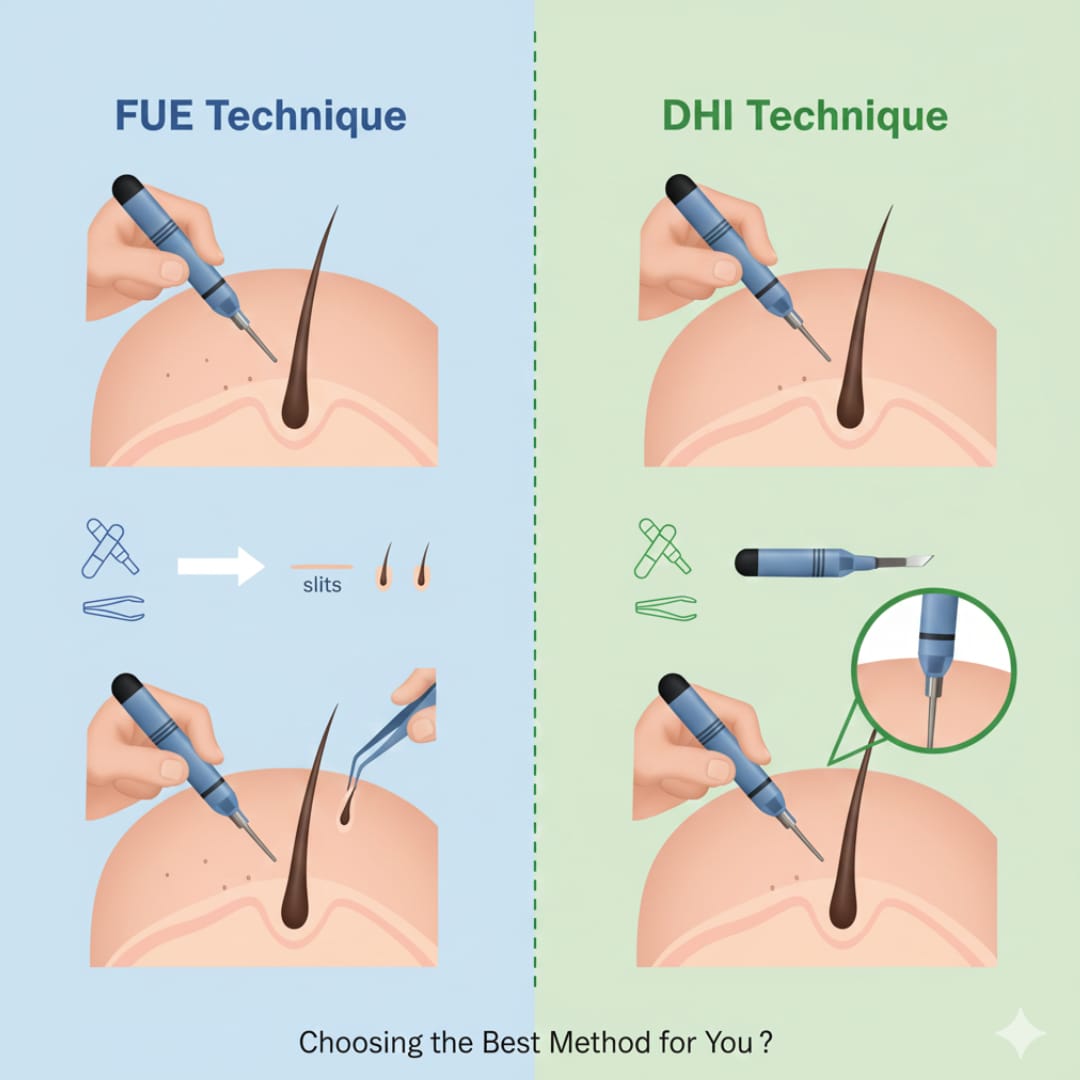
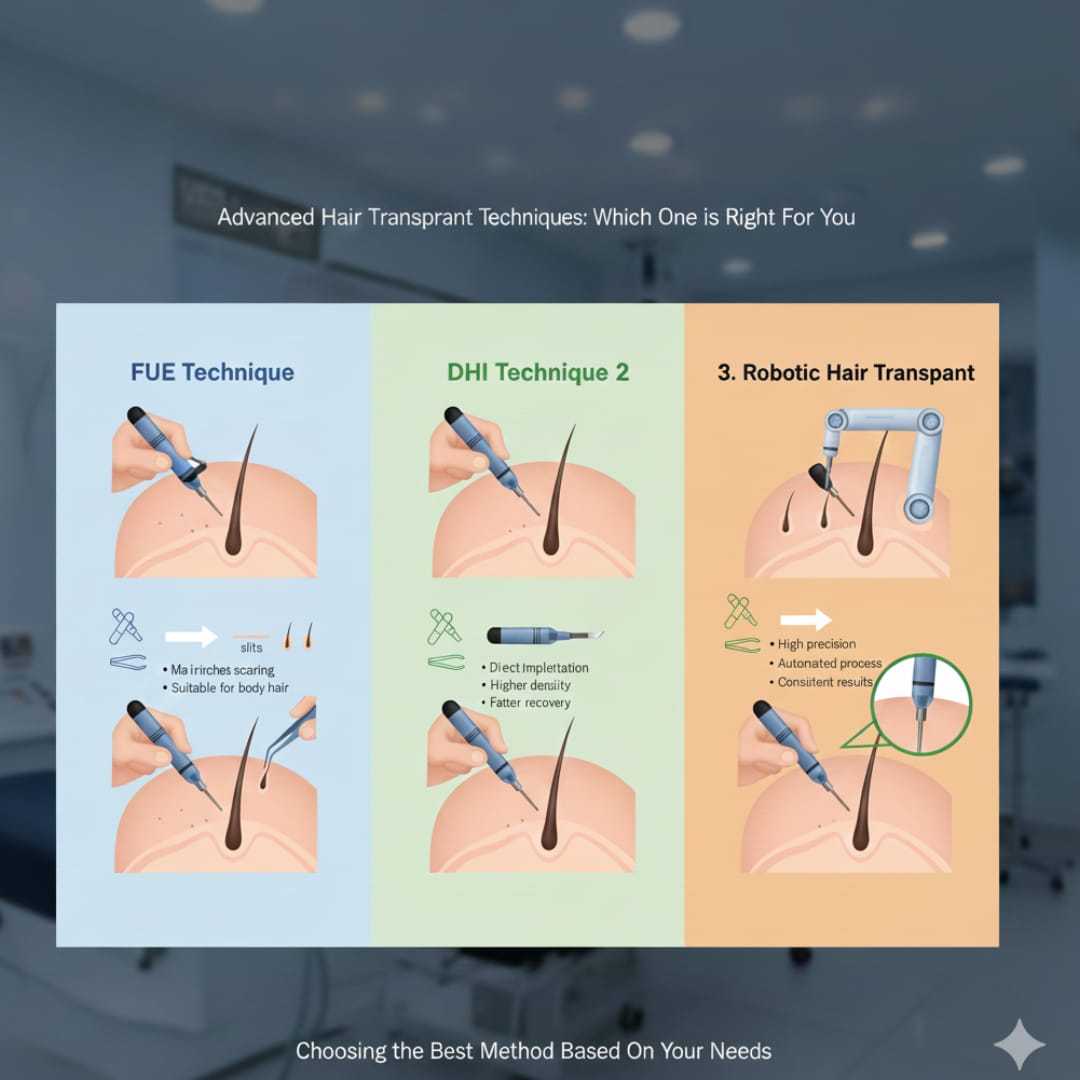
FUE (Follicular Unit Extraction) is the extraction of follicular units without the need to open channels, while DHI (Direct Hair Implantation) or Sapphire (a direct implantation technique using pens) is used to open channels with higher precision for a natural density. If the number of grafts is less than 1000, DHI is better for precision and faster healing. However, for over 1000 grafts, Sapphire is cheaper, faster, and better for large areas. The main difference is that DHI doesn’t require pre-drilling of channels.
The full result is between 8 to 12 months.
In months 3-4, hair growth begins, and by month 6, noticeable thickness appears.
The transplanted hair sheds from the day of the scabbing up to 45 days, about a month and a half. This is natural shedding, like shock loss. New hair grows in after 120 days from the procedure up to 240 days, with a gradual improvement in density. If you’re using minoxidil, growth speeds up a bit. Without it, the timeline is the same, but it might be slightly slower. The density phase of the transplanted hair growth begins after the initial growth phase ends.
Agriculture fills in the gaps…
But your original hair needs treatment to stop the hair loss.
Generally between 23 and 55 years old.
The goal is for hair loss to become relatively stable.
Yes, it is very safe if the doctor is skilled, the clinic is licensed, and uses sterilized instruments.
Based on:
The bald area.
The strength of the donor area.
Some people need one session, and some need two.
Possible…
But your sugar levels must be stable, and a medical evaluation is recommended before the procedure.
There are signs indicating that your scalp is regrowing hair, including: hair shedding. This means that new hair is emerging from the follicle and beginning to grow. It may take approximately six months after the transplant to see noticeable results.
Pain during a hair transplant is limited. The doctor performs a nerve block (an injection that numbs the nerves responsible for sensation in the area). Afterward, you don’t feel any further pain during extraction or transplantation, which makes the procedure completely comfortable. This is medically sound, as local anesthesia is used with nerve blocks to minimize pain, as standard medical procedures confirm.
Yes, the transplanted hair is your original hair and grows naturally, 100%.
The hair transplant procedure takes 6 to 8 hours and is done by extracting hair follicles from an area with high hair density and transplanting them to the area experiencing baldness or thinning hair.
Most cases: Yes.
DHI technique sometimes doesn’t require a complete shave.